
SENSUM – Smart SENSing of landscapes Undergoing hazardous hydrogeological Movement
|
October 2020 – September 2023. Principle Investigator: Dr Georgie Bennett, University of Exeter. UoP Co-investigators: Dr Irene Manzella, Prof Alison Raby, Dr Sarah Boulton, Prof Iain Stewart, Dr Andrew Prior, Dr Martin Stokes. 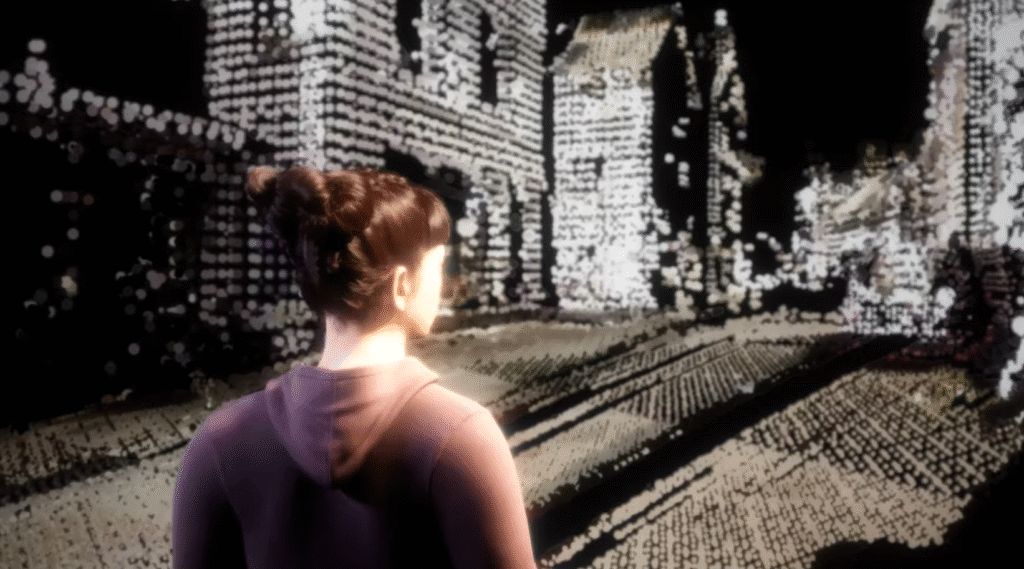 Along with Musaab Garghouti and UoP Post-doctoral researcher, Dr Alessandro Sgarabotto, we developed a 360 dome visualisation and sound design, based on these novel datasets and enhanced models of landslides and floods for SENSUM, a £1.2 million project funded by the Natural Environment Research Council (NERC) under its Constructing a Digital Environment programme and is being led by the University of Exeter in collaboration with the Universities of Plymouth and East Anglia. The film was shortlisted in the Sustainable Development (SDG) Film Festival 2024. Floods and landslides affect various parts of the world every year, both inland and along coastlines, causing disruption, occasional fatalities and severe economic loss. An increase in storminess under climate change and population pressure is resulting in an increase in these hazards, as well as threatening the defences put in place to manage them. Traditionally, landslides and floods have been monitored separately, using a combination of satellite-based remote-sensing techniques and wired ground-based instruments to measure factors such as river flow level, slope displacement and soil moisture. SENSUM proposed a new integrated way to tackle these hazards, taking advantage of advances in Wireless Sensor Network (WSN) and Internet of Things (IoT) technologies, microelectronics and machine learning. WSNs show great potential for monitoring and early warning of these hazards. Their main advantage is in the use of easily deployable, low-power sensors that enable continuous, long-term, low-cost monitoring of the environment. |